
Kayaking Through Tokyo for Tranquility and Cherry Blossoms
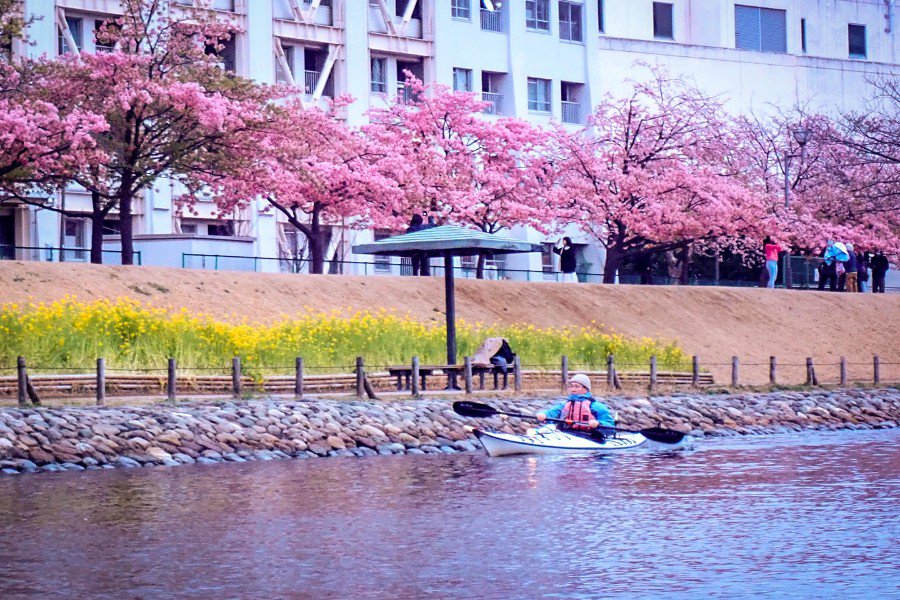 A unique way to experience Tokyo — from the water. Photo courtesy of Takashi Fukuda.
Sensory overload. Two words that best describe a first timer’s experience of Tokyo. Neon lights and flashing staircases. People going every which way at Shibuya Crossing. Anime characters on advertising billboards and even civic signage. Mind-boggling realistic displays of plastic food. Counter-culture youth of Harajuku. It’s a lot — a Godzilla-level of stimuli, if you will.
Over many trips to the Japanese megalopolis, I’ve managed to find calm within the urban frenzy, from the peaceful grounds surrounding Meiji Shrine on a drizzly late afternoon, to the trails of western Tokyo’s Mount Takao on a crisp, autumn day. However, on a trip to Japan’s capital in early March, I found peace not on the ground but on the water — by way of a kayak on the Kyunaka River.
Takashi Fukuda runs his kayaking operation, Mio Kayak Adventures, out of a van that serves as a mobile kayak gear shop in the parking lot of Ōjima-Komatsugawa Park. This quieter part of Tokyo is in the district of Edogawa, on the eastern bank of the Kyunakagawa (-gawa, meaning river). And it was on the banks that I put on neoprene water shoes and a neoprene “skirt” that secured me inside a kayak kept in a storage facility near the dock. A small group had signed up for Fukuda’s Tokyo waterway night paddling tour to see the sparkly lights of the city from a different perspective.
We paddled northbound upstream from Ōjima-Komatsugawa Park against a mild current, just as the sun was starting its descent below the horizon. We paddled between tree-lined banks and under a few bridges, including one where we could really feel the thunder of the Japan Railway Chuo-Sobu Line. It was an un-mistakenly urban moment on a supremely chill route through Tokyo; in some of the quieter sections you could even hear the splashing of water as ducks fluttered on the surface.
At the confluence with the Kitajukken River (technically a canal constructed centuries ago during the Edo Period), we kayaked westbound through the narrow channel between scenic pedestrian walkways built in the modern era. Our guide, Taka, stopped us at the turnaround point where the towering Tokyo Skytree, once the tallest building in the world, reflected almost perfectly on the surface of the Kitajukken.
Perhaps the most scenic sight of the kayak outing (surely, the most unexpected in late winter) was paddling the section leading up to the confluence, where the iconic sakura, i.e., cherry blossoms, had already started their bloom.
A beauty to behold for anyone, but particularly sacred in Japanese culture, the white and pink-hued cherry blossoms of Japan are considered a manifestation of the ancestral spirits and the divine; they’re also considered an embodiment of the Japanese Buddhist notion of mono no aware, a melancholy consciousness of the impermanence of life and its beauty within. Sakura only bloom for a few weeks each year before all their petals fall to the ground and into the river.
Our paddles propelled us back the way we came, this time downstream on the Kyunakagawa. Nightfall was upon us and the now-illumated arch of the Fureai Bridge caught our attention as it shined bright in the dark sky. In the end, the quiet kayaking excursion was one of the most remarkable experiences of all my times in Tokyo, a memory that will last beyond the fleeting life cycle of a sakura.
Takashi Fukuda’s day and evening Mio Kayak Adventures can be booked through Airbnb Experiences.