
Breakfast for Dinner, Squash for Dessert. Cooking with a Spanish Accent
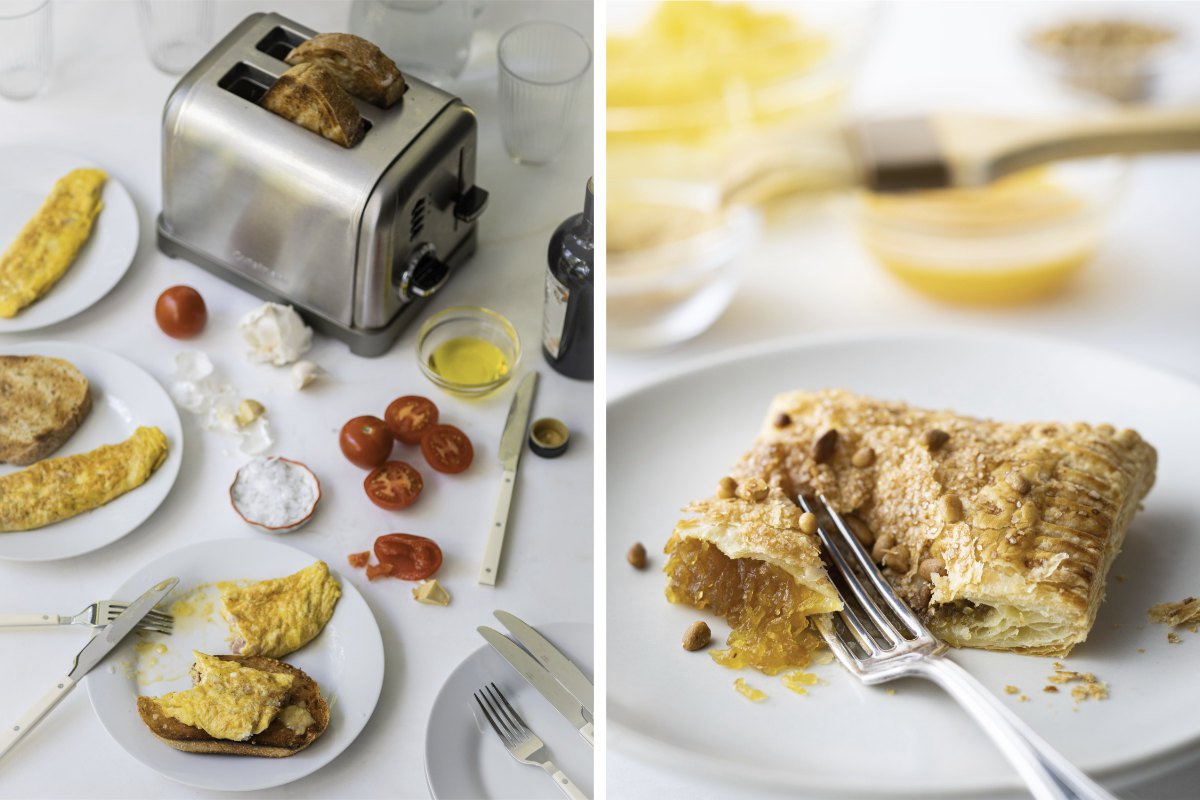 Dinner omelettes on the left, angel hair pastries on the right. Photos courtesy of Alfred A. Knopf.
Katie Button — chef, cookbook author, TV host, and co-founder of the James Beard Award-winning and Michelin-recognized Cúrate Tapas Bar in Asheville, North Carolina — has just published Spanish Accent: American Home Recipes with a Spanish Touch, a mash-up of Button’s favorite childhood recipes and home-cooked meal staples inspired by Spanish food, wine, and hospitality. We've featured her recipes on Fathom before, and were happy she shared two more from her new book — a savory and a sweet.
Dinner Omelets with Pan con Tomate
Sometimes I don’t have time to think about dinner, much less make it. That’s when I turn to breakfast for dinner, specifically a Spanish breakfast sandwich of pan con tomate sandwiched with jamón, seared pork loin, and melted cheese, or, my favorite, tortilla Francesa, a French-style omelet. This is not the “perfect” omelet. It’s homey and a little messy, and the only way you can screw it up is by feeling stressed out while making it. Heck, if you want to just make scrambled eggs with pan con tomate and call it a day, everyone will still be thrilled.
Serves 4
Ingredients
- 8 large eggs
- Diamond Crystal kosher salt and freshly ground black pepper
- 4 slices Black Forest deli ham, diced
- ½ cup shredded white cheddar cheese
- Extra-virgin olive oil, for the pan
- 4 large slices sourdough boule (see Notes)
- 1 garlic clove, halved
- 2 ripe and juicy red tomatoes, preferably Campari, halved crosswise
- Flaky salt such as Maldon or fleur de sel, for serving
- High-quality extra-virgin olive oil, such as Picual
Preparation
1. In a small bowl, whisk 2 eggs and season with kosher salt and pepper. Add one-quarter of the ham and 2 tablespoons of the cheddar.
2. Heat a 6-inch nonstick skillet over medium heat and add enough olive oil to coat the bottom of the pan. Pour in the egg mixture and cook until the eggs are set on the bottom, about 2 minutes. Then, gripping the handle, tilt the pan so that the egg begins to roll away from you. Using a fork or chopsticks, tuck the edge into the omelet and let sit until lightly browned, 1 to 2 minutes. Turn the omelet out onto a plate, seam-side down. Repeat to cook 3 more omelets.
3. While the omelets are cooking, toast the bread to your liking. Rub the cut side of the garlic lightly over the toasts (a little goes a long way—just a few light strokes on the toasted bread will work). Rub each toast with the cut half of a tomato so that the juices soak into the bread and you’re left with just the skins (these can be drizzled with a bit of olive oil and salt and eaten as a little snack). Sprinkle the toasts with flaky salt and drizzle with high-quality olive oil.
4. Enjoy the omelets with the pan con tomate, either sandwiched between the slices, alongside, or however you feel.
Notes
If you prefer using a baguette, slice it in half lengthwise, then cut each half into large pieces before toasting.
When we have this for dinner, I like to put the toaster in the middle of the dining room table so everyone can toast and top to their liking. And if I’m really going for the best pan con tomate ever, I rub the garlic and tomato on both sides of my toast.
Cabello de Ángel-Filled Pastries
The first time I ordered this in Spain, I couldn’t believe the filling was made from strands of squash. It was sweet and soft, with a texture a little gooier than marzipan. Back home, I realized I could re-create it pretty easily with a few shortcuts. The first is using the microwave to cook the squash, and the second is opting for store-bought puff pastry. While making the cabello de ángel (angel hair) can be a bit time-consuming, it’s a fun process and most of the time isn’t active prep. I often make the caramelized squash a week or two in advance of a special occasion and keep it in the fridge. It also freezes beautifully, so you can make a big batch and thaw it as needed. Once you have the filling ready, assembling the pastry is a snap. The result is a show-stopping dessert that’s sure to wow your friends and family. It’s delicious served warm or at room temperature.
Makes 12 pastries
Ingredients
- 1 spaghetti squash (about 2½ pounds)
- 1¾ cups granulated sugar
- Grated zest and juice of 1 lemon
- All-purpose flour, for dusting
- One 14-ounce package frozen puff pastry (see Notes), thawed
- Egg wash: 1 large egg whisked with 1 tablespoon milk, buttermilk, or cream
- 2 tablespoons pine nuts
- Demerara or turbinado sugar, for sprinkling
Preparation
1. Pierce the squash all over with a fork, place on a microwave-safe dish, and microwave for 5 minutes. Transfer to a cutting board. Using a towel to hold the hot squash, slice it in half lengthwise. Scoop out and discard the seeds, but be careful not to scoop out the flesh. Place one half of the squash cut-side down in an microwave-proof dish with ¼ cup water and microwave again for about 5 minutes; at this point the squash should be very tender and super easy to pierce with a knife (see Notes). Transfer the squash to a bowl and repeat with the other half. Set aside until cool enough to handle.
2. Using a fork, scrape out the insides of the spaghetti squash in long strands.
3. In a sauce pot, combine the squash, ¼ cup water, the granulated sugar, lemon zest, and lemon juice. Bring to a simmer and cook over medium-low heat, stirring often, until all the liquid has evaporated and the sugar and squash have begun to caramelize, about 1 hour. You will be left with a thick, caramelized candied squash mixture. Transfer to a heatproof container and refrigerate until chilled.
4. Preheat the oven to 375°F. Line a rimless baking sheet with parchment paper.
5. On a lightly floured work surface, lightly flour the top of the puff pastry. Gently roll out the pastry to a ⅛-inch thickness. Cut the pastry in half and transfer one sheet to the prepared baking sheet. With your hands, gently spread the squash filling over the pastry on the sheet, leaving a 1-inch border.
6. Brush the egg wash along the edge of the pastry with the filling. Lay the other pastry sheet on top and press the edges together. With a fork, crimp the edges all the way around to ensure the pastry is well sealed.
7. Brush the top of the entire pastry with egg wash and sprinkle the pine nuts and Demerara sugar thoroughly over the top.
8. Bake until the pastry is puffed and well browned, 25 to 35 minutes. (If it’s still light brown, the pastry is underbaked.) Let cool, cut into 12 rectangles, and serve.
The candied squash can be refrigerated for 1 month. The finished pastries can be wrapped in plastic and refrigerated for up to 5 days.
Notes
Some puff pastry is sold in 17.3-ounce packages. If you buy this, don’t cut the sheet in half as directed in step 5. Just roll out both sheets to a ⅛-inch thickness and spread the squash filling over one sheet, leaving a 1-inch border. Proceed as directed.
Timing on the squash can vary depending on its size as well as your microwave. It’s important that the strands of squash be soft and not crunchy. If they are still raw, you may need to add a little water and microwave for a bit longer.
Keep Cooking
Buy Spanish Accent: American Home Recipes with a Spanish Touch online at bookshop.org or amazon.com or IRL at your favorite local bookstore.
From Spanish Accent © 2026 by Katie Button with Kate Heddings. Excerpted by permission of Alfred A. Knopf, a division of Penguin Random House LLC. All rights reserved. No part of this excerpt may be reproduced or reprinted without permission in writing from the publisher.